
In 2024, Ziraat Katılım has determined the environmental and climate-related impacts of its operations, as well as its key performance indicators.
The Integrated Management System (IMS) was integrated into the Bank’s ERP system to manage the consumption data of natural resources and waste.
Ziraat Katılım’s carbon management is based on developing strategies to support the transition to a low-carbon economy in line with Türkiye’s 2053 Net Zero Emission goal and offering innovative solutions to promote this transformation. Ziraat Katılım aims to contribute to the reduction of carbon emissions by involving its customers and stakeholders in this transformation process while fulfilling its responsibilities in carbon management.
In 2024, Ziraat Katılım has determined the environmental and climate-related impacts of its operations, as well as its key performance indicators. The Bank utilizes the GHG Protocol to calculate its greenhouse gas emissions.
In 2023, the Integrated Management System (IMS) was integrated into the Bank’s ERP system for the management of consumption data on natural resources and waste in order to improve the efficiency of the carbon footprint and water footprint studies arising from Ziraat Katılım’s operational activities. In 2024, endeavors were undertaken to develop and improve the system. System definitions for newly included items in the GHG inventory are being carried out, while monitoring mechanisms and system frameworks are being planned for emission categories to be included in the calculations.
This module, which serves as a starting point on the way to the ISO14001 Environmental Management System, enables the efficient management of data from various branches of the Bank and the Headquarters, including entry, tracking, and reporting.
Emission Management
Within the frame of Scope 3 emissions, the Bank has established the data collection infrastructure to measure emissions from waste, fuel consumption of employee shuttles, and rental vehicles, as well as paper consumption indicators. Efforts for the measurement of financed emissions are currently in the planning phase.
Studies are planned to be conducted to improve the quantity and quality of the data stored in the module, which was developed to fully measure Scope 1, Scope 2, and Scope 3 greenhouse gas emissions.
Aiming to measure greenhouse gas emissions in accordance with ISO14064* criteria and the GHG protocol, the Bank plans to enhance the integrity of its climate and environmental performance by diversifying the types of resources and wastes defined in its inventory.
Ziraat Katılım, which monitors and records its Scope 1 and 2 assets and the energy-related emissions it purchases, has been calculating Scope 1, 2, and 3 emissions in its service cycle since 2023.
*ISO 14064 specifies the principles and requirements for the quantification and reporting of greenhouse gas emissions and removals at the organization level.
Sağa kaydırarak tablonun devamını görebilirsiniz.
| Greenhouse Gas Emissions (ton CO₂e) | |||
| Indicator | 2022 | 2023 | 2024 |
|
Scope 1 |
1,838 |
2,253 |
2,697 |
|
Scope 2 |
2,485 |
2,896 |
104* |
|
Scope 3 |
1,413 |
1,781 |
1,216 |
|
Total (Scope 1+Scope 2) |
4,322 |
5,149 |
2,801 |
*Emissions from Electricity Purchased are calculated as “0” since electricity consumption in 2024 is I-REC certified. Within Scope 2 emissions, only heat-related emissions are calculated as “104 tons CO2e.”
Sağa kaydırarak tablonun devamını görebilirsiniz.
| Emission Intensity | |||
| Indicator | 2022 | 2023 | 2024 |
|
Intensity per employee (tCO₂e/number of employees) |
2.27 |
2.12 |
0.98 |
|
Emissions by consolidated asset size (tCO₂e/TL million) |
0.02 |
0.01 |
0.005 |
|
Emissions by consolidated net profit (tCO₂e/TL million) |
1.14 |
1.29 |
0.81 |
Sağa kaydırarak tablonun devamını görebilirsiniz.
| 2024 Scope 1 and Scope 2 Greenhouse Gas Emissions by Consumption Sources (%) | |
| Consumption | Percentage Distribution |
|
Natural Gas-Stationary Combustion |
36.01% |
|
Generator-Other Stationary Combustion |
0.23% |
|
Gasoline–Mobile Combustion |
31.93% |
|
Diesel–Mobile Combustion |
26.05% |
|
Refrigerant Gases |
2.08% |
|
Fire Extinguisher |
0.00% |
|
Electricity Purchased* |
0.00% |
|
Heat |
3.70% |
*Emissions from Electricity Purchased are calculated as “0” since electricity consumption in 2024 is I-REC certified. Within Scope 2 emissions, only heat-related emissions are calculated as “104 tons CO2e.”
For Ziraat Katılım’s carbon reduction, quantitative goal-setting studies are being carried out primarily for Scope 1 and Scope 2 emissions and subsequently for Scope 3 emissions. Adopting the SBTi approach, the Bank envisages to set science-based carbon reduction goals.
Greenhouse gas emission calculations for 2024 have been carried out in accordance with GHG Protocol standards and a verification statement has been obtained from an independent verification company. In order to offset emissions from electricity consumption, I-REC certificates for 14,350 MWh of wind energy were purchased and emissions from purchased electricity were offset.
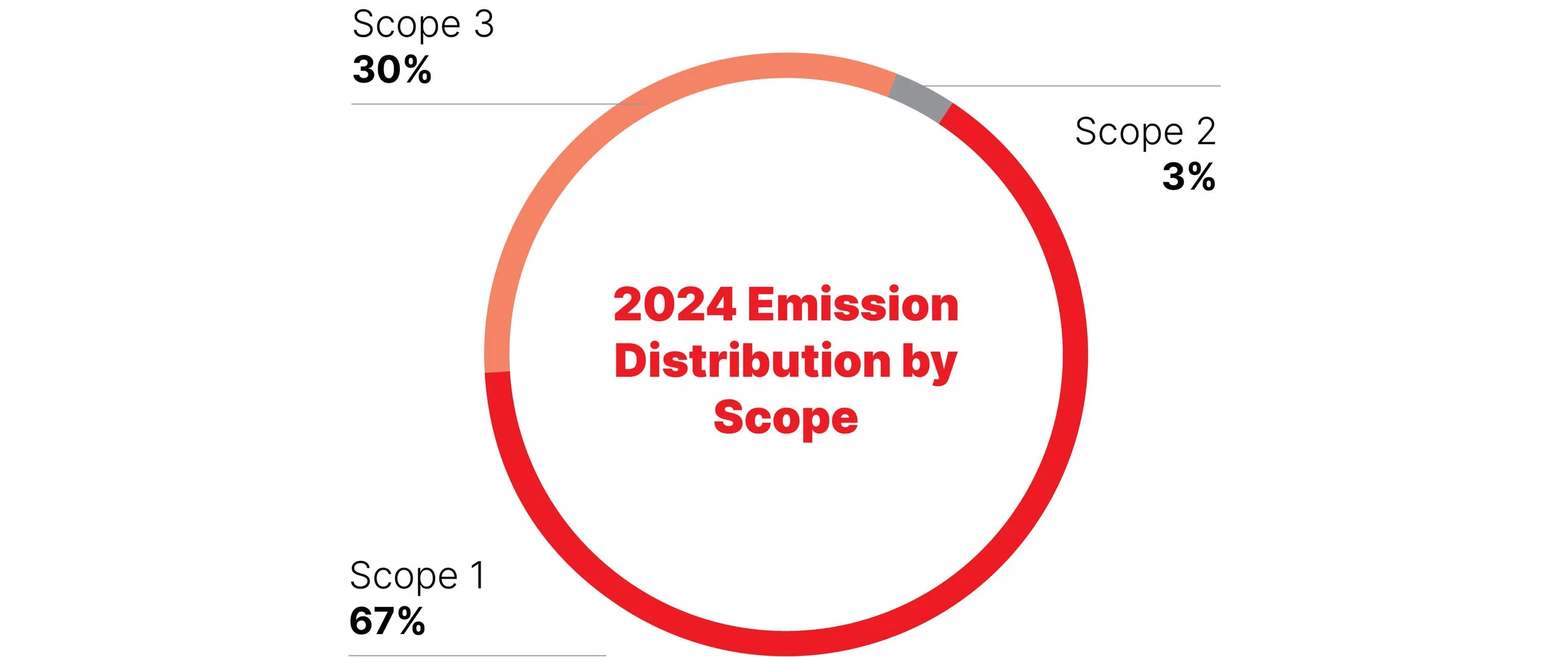
61% of total emissions are from Scope 1, 3% from Scope 2, and 30% from Scope 3. The largest shares of Scope 1 and Scope 2 emissions are natural gas consumption with 36.01% and gasoline consumption with 31.93%. In addition, 26.05% of the emissions originated from diesel fuel consumption, 3.70% from heat, and 2.08% from refrigerants.
The tables on the side present the distribution of emissions in 2024 by scope and consumption source. Detailed data can be found in the Environmental Performance Indicators part of the Performance Indicators section of the report.
Following the studies on the emission calculations of the sectors prioritized in the heat map within the scope of the Bank’s portfolio emissions, the Bank will create mitigation plans on the basis of the sectors prioritized in the portfolio in the coming period.
Energy Management
Supporting and expanding renewable energy projects in line with Türkiye’s 2053 Net Zero Emission goal is one of the key elements of the Bank’s sustainability strategy.
Ziraat Katılım procures electricity for its own consumption from local companies. The Bank regards the use of renewable energy as a critical opportunity for both environmental sustainability and economic development.
Moreover, market-based emission studies are evaluated regarding the energy consumption arising from the Bank’s operational processes. Having completed its energy consumption calculations, the Bank finalized its renewable energy certificates, the I-REC Certificate, simultaneously with its emission calculations.
Additionally, in 2024, assessments were made to take action to reduce and optimize energy consumption across branches based on the outputs of the pilot energy monitoring system implemented for the Kayaşehir branch in 2023. In this context, a plan has been made to monitor consumption trends periodically, taking into account that the reduction in energy consumption to be achieved by the actions will vary seasonally.
Integrated Annual Report of Ziraat Katılım Bank covers the period from January 1, 2024 to December 31, 2024.
You can share your feedback and suggestions regarding the Ziraat Katılım Bank A.Ş. 2024 Integrated Annual Report via email.